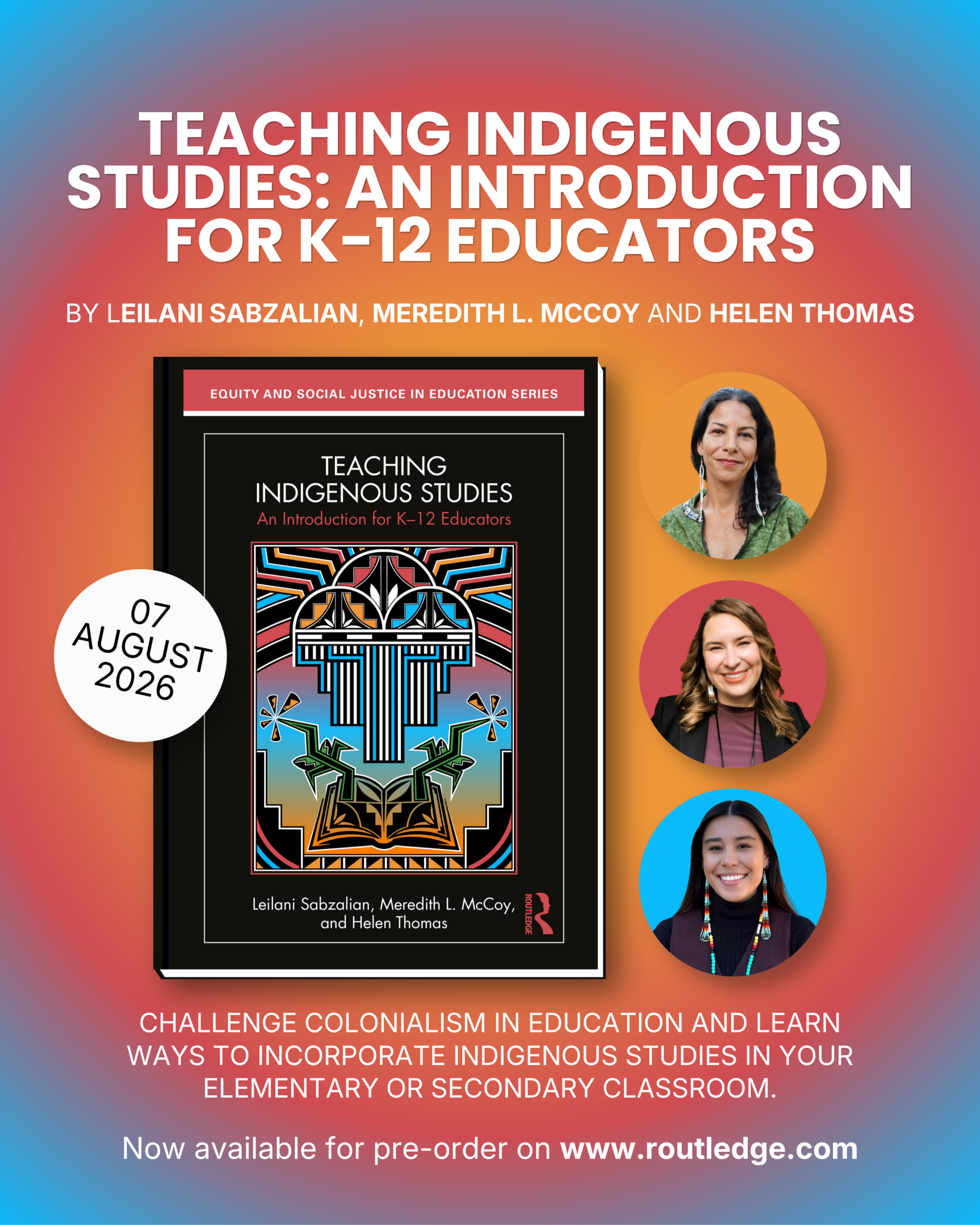
Teaching Indigenous Studies: An Introduction for K-12 Educators
I am thrilled to announce a new book for K-12 educators, co-authored with Leilani Sabzalian (Alutiiq/Sugpiaq) and Helen Thomas (Hunkpapa Lakota, Standing Rock Sioux Tribe). Now available from Routledge, the book offers foundational knowledge around the movement for Indigenous studies curriculum in K-12 schools, as well as strategies to support more respectful and responsible teaching of Indigenous studies. Chapters will help teachers learn about Indigenous pedagogies and how to integrate foundational ideas such as sovereignty, survivance, and relationality into their teaching and curriculum. Through a keywords approach, chapters offer conceptual introductions, connections to classroom practice, and a wide array of teaching strategies and resources to help teachers move learning into practice. Through the book, we hope teachers will build strategies to name and disrupt colonialism, recognize and affirm Indigenous identities and knowledges, foster ethical land relations, and identify their roles and responsibilities in relation to decolonization and resurgence.
On Our Own Terms: Indigenous Histories of School Funding and Policy
Thanks to the University of Nebraska Press for publishing my first book, On Our Own Terms: Indigenous Histories of School Funding and Policy, in 2024.

On Our Own Terms contextualizes recent federal education legislation against two hundred years of education funding and policy to explore two critical themes: the racial and settler colonial dynamics that have shaped Indian education and the equally long and persistent tradition of Indigenous peoples engaging schools, funding, and policy on their own terms. Focusing primarily on the years 1819 to 2018, it shows some of the diverse strategies families, educators, and other community members have used to creatively navigate schooling. These stories of strategic engagement with schools, funding, and policy embody what Gerald Vizenor has termed survivance, an insistence of Indigenous presence, trickster humor, and ironic engagement with settler structures. By gathering these stories together into an archive of survivance stories in education, the book invites us to consider ongoing patterns of Indigenous resistance and the possibilities for bending federal systems toward community well-being.
